
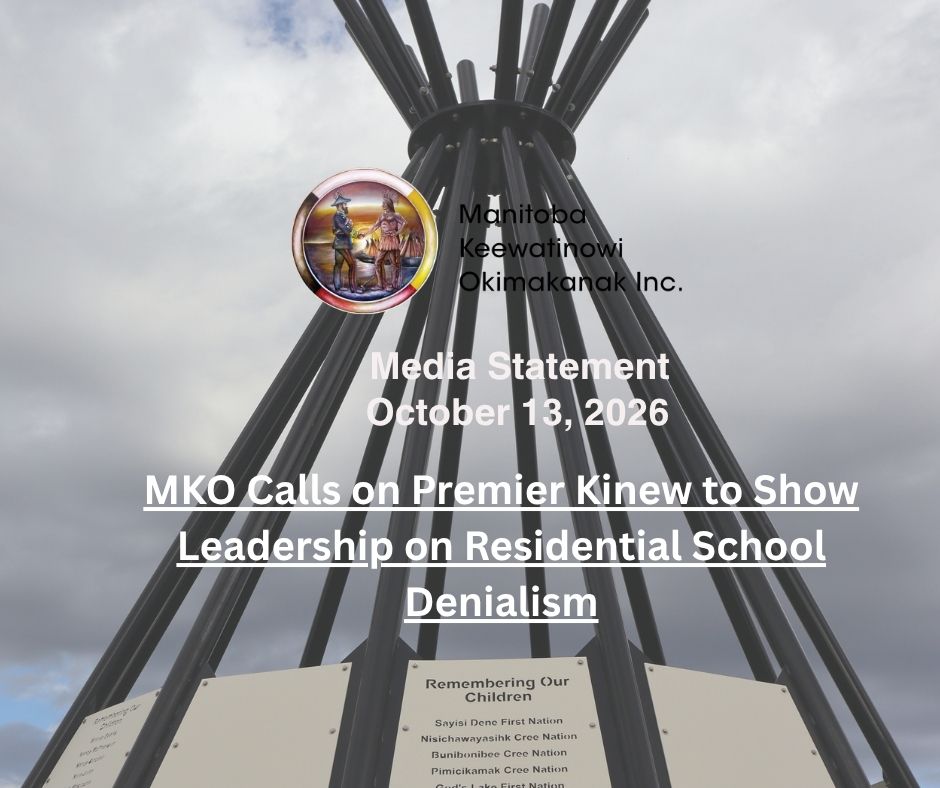
Treaty 1 Territory, Winnipeg, Manitoba – Manitoba Keewatinowi Okimakanak (MKO) is deeply disappointed by Premier Wab Kinew’s position that Indian Residential School denialism should not be criminalized and that education should instead be relied upon to confront this growing and harmful form of hatred.
Education is essential to reconciliation, but education alone cannot protect Survivors and First Nations families from deliberate hate, harassment and attempts to erase their lived experiences.
MKO Grand Chief Garrison Settee stated:
“We expect more from this Premier. Premier Kinew understands, in a deeply personal way, the history that First Nations people carry and the responsibility that comes with leadership. As an Indigenous leader occupying the most powerful political office in Manitoba, he has an opportunity to lead this country, not simply follow the status quo.”
Grand Chief Settee continued, “Survivors lived this history. Children were taken from their families. Families continue to live with the consequences. First Nations are still searching for children who never came home and working to protect the places where they may be buried. When people deliberately deny, mock or distort that truth, the harm is real. Survivors should not have to continually prove what happened to them.”
Those working directly with Survivors and affected families see the consequences of denialism. Survivors, families, First Nations leaders and advocates can face hateful comments, racist attacks and denialist rhetoric, particularly when speaking publicly about Residential Schools, searches of former school sites, missing children and the protection of burial sites.
Canada has already recognized through the Criminal Code that certain deliberate forms of historical denial can cross the line into hate. Indian Residential School Survivors do not have an equivalent protection.
The gravity of the issue cannot be dismissed. In September as many as 30 people reportedly affiliated with a white nationalist group trespassed on Tk’emlúps te Secwépemc lands near the former Kamloops Indian Residential School and displayed a banner mocking the search for missing children.
Grand Chief Garrison Settee said:
“There comes a point when governments must decide whether reconciliation is simply something they speak about or something they are prepared to defend. Premier Kinew is uniquely positioned to demonstrate what Indigenous political leadership can accomplish from within government. We respectfully but firmly call upon him and the Government of Manitoba to reconsider this position and lead a national conversation with First Nations and Survivors about meaningful legislative protections against Residential School denialism.”
At the Assembly of First Nations Annual General Assembly in Ottawa in July 2026, Chiefs-in-Assembly unanimously passed an Emergency Resolution introduced by Pimicikamak Cree Nation Chief David Monias and seconded by MKO Grand Chief Garrison Settee, acting as proxy for Chemawawin Cree Nation, calling upon Canada to work with First Nations to criminalize Indian Residential School denialism as hate speech and establish stronger protections for Survivors, their families and First Nations communities.
That direction from First Nations leadership deserves a serious response from governments.
MKO calls upon the Government of Manitoba to stand with Survivors, engage directly with First Nations leadership, and urge Canada to co-develop effective legislative protections against deliberate Residential School denialism and hate.
Grand Chief Garrison Settee concluded:
“Reconciliation requires courage. It requires governments to stand with Survivors even when doing so is politically difficult. Premier Kinew has an opportunity to lead. We are calling on him to use the power of his office, his voice and his unique place in Canadian political history to help ensure that the truth of Residential Schools can never again be erased.”
-30-